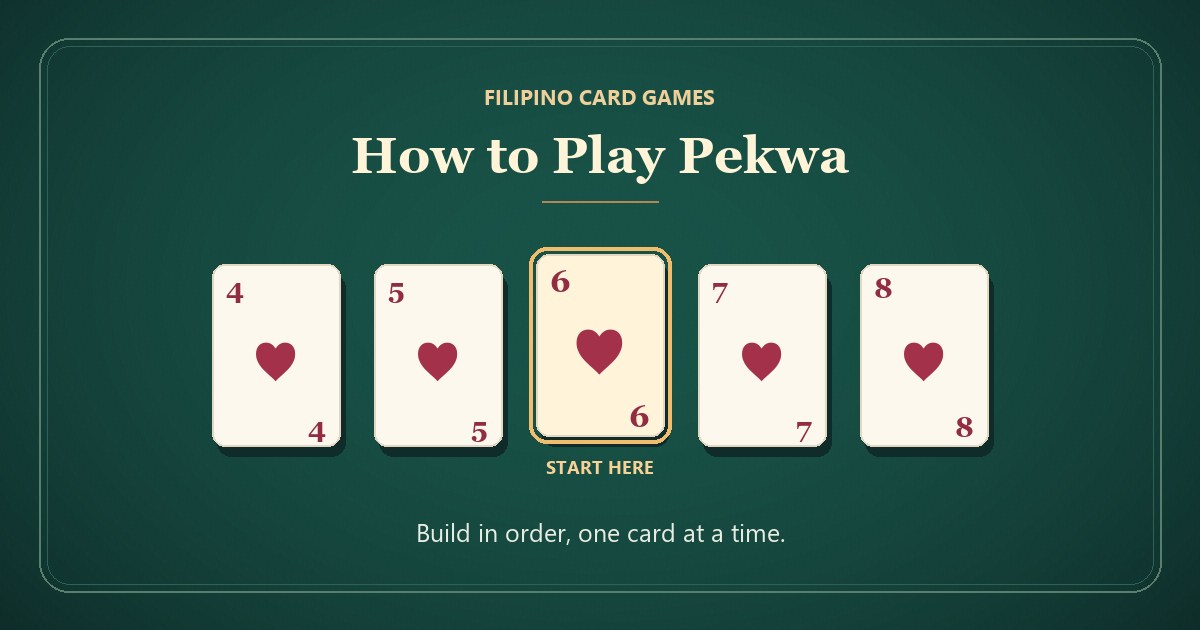
Pekwa is a Filipino card game where you build four rows, one for each suit, and try to play your last card before anyone else. In the version taught here, each row opens with its six. From there, cards go down to the ace on one side and up to the king on the other. You play one card per turn and pass only when you have no play.
What Pekwa is
Pekwa belongs to the Fan Tan family, also called Sevens or Card Dominoes. A six-start version is documented under the Philippine name Pekwa, while the usual Sevens layout opens on sevens. Ask which rank opens the rows before you deal.
If your table starts with sevens, two things change together: use sevens for all four suits, and agree where the ace sits, since some tables put it below the two and others above the king. The rules below use sixes and put aces below twos.
The deal
Gather three to six players and a standard 52-card deck without jokers. Pick a dealer, shuffle, and deal one card at a time, face down, clockwise from the player on the dealer’s left. Deal all 52 cards. There is no draw pile, so each card you need is already in someone’s hand or on the table.
With four players, everyone gets 13 cards. With three, one player gets 18 and the other two get 17. With five, two players get 11 and three get 10. With six, four players get nine and two get eight. The extra cards are part of the deal. You can move the deal one seat clockwise between hands so the same seats do not always get them.
The player to the dealer’s left takes the first turn, and play moves clockwise. Agree on this before dealing if your group normally gives the first turn to the holder of a particular starting card.
How the six starts a row
Leave space for four rows: hearts, diamonds, clubs, and spades. A six starts the row for its own suit. Once the 6♥ is down, the row can grow toward 5♥, 4♥, 3♥, 2♥, and A♥ on one side, and toward 7♥, 8♥, 9♥, 10♥, J♥, Q♥, and K♥ on the other.
The two ends advance independently. A row showing 5♥, 6♥, and 7♥ can take either 4♥ or 8♥. The player with 8♥ can play it even if 4♥ has not appeared. The 9♥ has to wait until 8♥ is on the table. A♥ goes next to 2♥, and K♥ ends the high side.
What you can play on your turn
- Open a suit by playing its six if that row has not started.
- Extend an open row by playing the next card at either end. The rank must be adjacent and the suit must match.
- If you have any of those plays, choose one and play exactly one card. If you have none, pass.
Suppose the only open row is hearts, and it shows 5♥, 6♥, and 7♥. You hold 4♥, 9♥, 6♣, and 5♣ among your cards. You can extend hearts with 4♥ or open clubs with 6♣. You cannot play 9♥ until 8♥ is down. If you choose 6♣, the next player can extend clubs with 7♣ if they hold it. The 5♣ stays in your hand until another turn.
When you have a choice, look at what each play opens. If you also hold 3♥, playing 4♥ gives you a move for a later turn. If several of your clubs are waiting for the club row to open, the 6♣ may be a better use of this turn.
Passing and counting points
Say “pass” if none of your cards fits anywhere. Check your hand for an unplayed six before you give up your turn. You keep the cards you have and the next player goes. The layout may change before play comes back to you.
For a first game, you can keep score by counting hands won. If your group wants to track penalties across several hands, agree on one point per pass and one point per card still in your hand when someone goes out. Chips can serve as counters. For example, two passes and three cards left give you five penalty points. If you use this system, the lowest total after an agreed number of hands wins the session.
How a hand ends
As soon as a player puts down their last card, that player wins the hand. Play stops there. You can win while some rows are unfinished or a suit has yet to open. If you are keeping penalty points, count the cards everyone else is still holding before gathering the deck.
Three common mistakes
- Skipping a rank. If hearts ends at 7♥ on the high side, 9♥ has to wait for 8♥.
- Matching the rank but missing the suit. The 8♦ cannot extend a row ending in 7♥. It belongs in the diamond row and needs 7♦ there first.
- Passing to hold back a useful card. If your only available play is opening clubs with 6♣, you must play it.
FAQ
Is Pekwa the same as Fan Tan?
It is the Philippine name for a game in the Fan Tan family. The version here uses a six to open each row. The usual Sevens version uses a seven, so a newly opened row can first take a six or an eight of that suit.
Can two people play Pekwa?
This guide is for three to six players. A two-player deal would give each person 26 cards. Learn with at least three players if you want to follow these rules as written.
Can I play a six after other suits have opened?
Yes. As long as its own suit has not opened, you can use that six to start a row on any of your turns.
Do we need chips to play?
No. You can count hands won or keep penalty points on paper.
For more Filipino card games, try Tongits for a three-player game, compare Pusoy with Pusoy Dos, or learn Ungguy-unggoyan and 1-2-3 Pass.
Sources
- Cats at Cards, Fan Tan and variants documents Pekwa’s six-start layout and the related low-ace rules.
- Pagat, Card Games in the Philippines lists Pekwa as a Philippine name for Fan Tan.
- Pagat, Fan Tan / Sevens describes the seven-start layout and its variations in ace placement, first turn, and scoring.
Educational content. 18+ only.