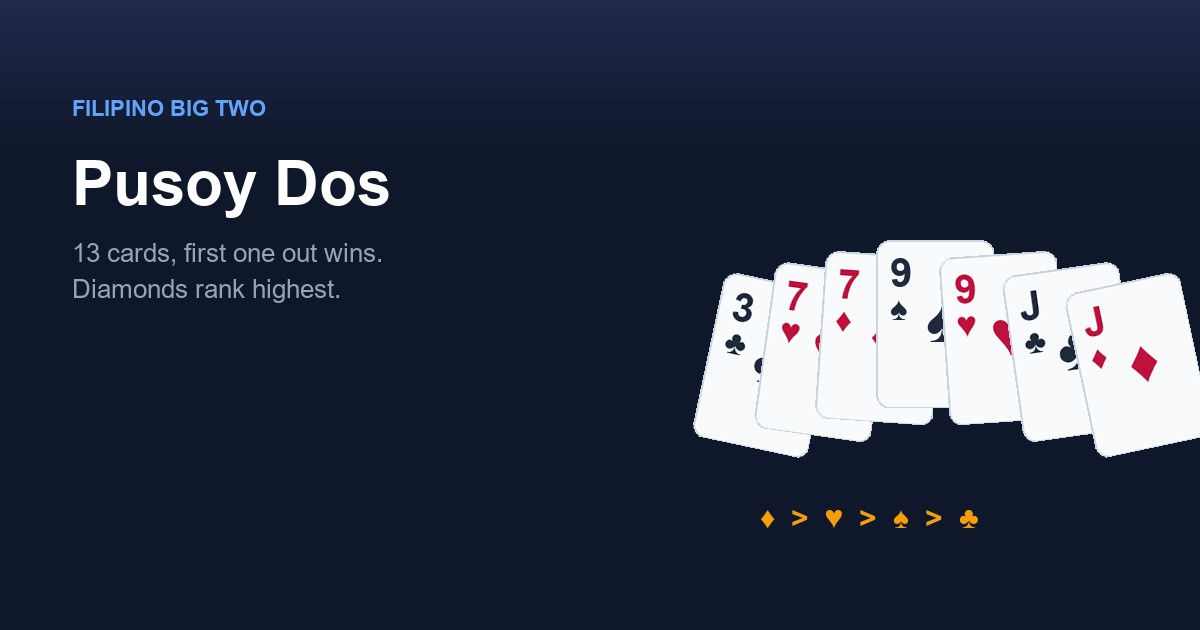
Pusoy Dos is the Filipino name for Big Two, a climbing game for four players, each playing for themselves, with a 52-card pack. Each player gets 13 cards and tries to empty their hand by beating the previous play with a higher single, pair, triple or five-card poker hand. The first player out wins and scores for any twos in the final play.
Quick reference
| Item | Detail | | Players | 4 (3 or 2 with adjustments) | | Deck | One standard 52-card pack | | Rank order | 2 high, then A down to 3 | | Suit order | ♦ > ♥ > ♠ > ♣ | | First lead | Holder of 3♣ | | Scoring | 1, 2, 4, 8 or 16 positive points |
What pusoy dos is
Pusoy means poker in Filipino, so Pusoy Dos translates as Poker Two. The game is also called Big Two, Big Deuce or Deuces in English. You may see the spellings Chikicha and Sikitcha; Pagat treats Sikitcha as a close variant, not an exact synonym, so this page uses Pusoy Dos throughout.
Pusoy dos vs pusoy
Pusoy and Pusoy Dos are different games with similar names. Pusoy is the 13-card partition game: split 13 cards into a back hand of five, a middle hand of five and a front hand of three, then compare the three hands. Pusoy Dos is a shedding game: play higher combinations and race to empty your hand. Our Pusoy guide covers the partition game.
The deck, the deal and the first lead
Shuffle one standard 52-card pack and deal one card at a time, face down, anticlockwise, until each of the four players has 13 cards. There is no stock and no draw pile. No jokers are used.
The player holding 3♣ leads the first play. The first play must include 3♣, either as a single or as part of a valid combination. Clubs are the lowest suit in Pusoy Dos, so 3♣ is the lowest card in the pack; that is why it starts.
Card rank: twos high, threes low
Rank runs 2, A, K, Q, J, 10, 9, 8, 7, 6, 5, 4, 3 from high to low. The 2 outranks the ace, and the 3 is the lowest rank. This order applies to singles, pairs and triples, and to the rank comparisons inside five-card hands, except in straights, where the 2 is low.
Suit rank: diamonds first
When two plays have the same rank, suits decide. The Pusoy Dos order is ♦, ♥, ♠, ♣ from high to low: diamonds beat hearts, hearts beat spades, spades beat clubs. So 7♦ beats 7♥, and a pair of 9s containing 9♦ beats a pair of 9s containing 9♠. This is the Philippine order and is not the same as the Hong Kong order, where spades come first: under that order 7♥ would beat 7♦ instead.
The five combinations
Every play must match the shape and size of the play before it. There are four shapes.
A single is one card. A pair is two cards of the same rank. A triple is three cards of the same rank. A five-card hand is exactly five cards and comes in five types, ranked straight, flush, full house, four of a kind, straight flush. These are the standard poker hand rankings used in most poker games.
A single can only be beaten by a higher single; a pair by a higher pair; a triple by a higher triple; a five-card hand by a higher five-card hand.
Singles, pairs and triples compare rank first. If the rank is equal, compare the highest suit in the play: a pair of 9s containing 9♦ beats a pair of 9s containing 9♠.
Five-card hands compare type first. A flush beats a straight, a full house beats a flush, four of a kind beats a full house, and a straight flush beats four of a kind. Within the same type, compare the cards that define it: the highest card of a straight or straight flush, the highest card of a flush and then the next, the trips then the pair of a full house, and the rank of the four of a kind. Four of a kind must be played with a fifth card; four cards alone are not a valid play.
Straights, and where the ace goes
A straight is five cards of consecutive rank. In Pusoy Dos the 2 sits below the 3, not above the ace. The highest straight is A-K-Q-J-10. The lowest is 5-4-3-2-A, with the ace playing low. The ace may appear only at the ends of a straight, so 3-2-A-K-Q and 2-A-K-Q-J are not valid. A 2 can appear only in 5-4-3-2-A; it does not make a higher straight.
Passing, and when the round resets
When the action reaches you, you may pass or beat the previous play with the same shape and size. You may pass even when you could beat the play; there is no obligation to play. Passing does not lock you out: when the action comes back around, you may play after all.
When every other player passes in succession, the last player to play takes the round, sets the cards aside and leads any valid shape. The others must follow that shape.
How a hand ends
The deal ends when a player plays their last card or combination. The other players do not get one more chance to beat it; the play stops immediately.
That player wins the deal. The others still hold cards, but in the Philippine scoring they do not lose points for those cards; they simply score nothing. The winner’s score depends only on the final play.
A player cannot go out on a pass. The last play must be a valid single, pair, triple or five-card hand, and it must be played in the normal way. In most groups the winner of the deal leads the first play of the next deal.
How a hand is scored
Pusoy Dos uses positive points, not penalties. Only the winner scores. A final play with no 2 is worth 1 point. Each 2 in the final play doubles the score: one 2 gives 2 points, two 2s give 4, three 2s give 8, and all four 2s give 16.
The other players score nothing, however many cards they still hold. Points are never subtracted from anyone. If you play several deals, add each winner’s points and agree the target before you start.
A worked example
Four players are in, and Ana holds 3♣, so Ana leads. Only the cards used in the example are shown.
Ana leads 3♣ as a single. Ben plays 7♥. Cia plays 7♦. Dee passes, Ana passes and Ben passes. Cia wins the round with 7♦.
The two 7s have the same rank, so the suits decide. Diamonds beat hearts in Pusoy Dos, so 7♦ beats 7♥. Under the Hong Kong order, where spades beat hearts, diamonds and clubs, 7♥ would beat 7♦ instead.
Cia now leads 9♥ 9♠, a pair. Dee answers with J♣ J♦, a higher pair. Ana passes, Ben passes and Cia passes, so Dee wins the round and leads next.
The cards used in the two rounds are 3♣, 7♥, 7♦, 9♥, 9♠, J♣ and J♦: seven different cards, no repeats. The first player to empty all 13 cards wins the deal, and any 2s in that final play set the score.
Variations
Three-player Pusoy Dos needs an adjustment. Pagat’s Big Two adaptation deals 17 cards each and leaves one card face up in the centre for the holder of the lowest card; the four-player game on this page is the standard version. Two-player games vary in how many cards are dealt, so agree the number before the deal. Other regions use a different suit order, and the Sikitcha variant is close but not identical.
FAQ
Is pusoy dos the same as pusoy?
No. Pusoy splits 13 cards into three hands and compares them; Pusoy Dos is a shedding game.
Is pusoy dos the same as big two?
The mechanism is the same, but the Philippine suit order and positive scoring differ from the Hong Kong and Taiwan versions.
Which card starts the first hand?
The holder of 3♣ starts, and the first play must include it; clubs are the lowest suit, so 3♣ is the lowest card.
Can you pass and then play later in the same round?
Yes. Passing is only a decision for that moment; when the action reaches you again, you may still play.
Sources
- Pagat, Big Two: https://www.pagat.com/climbing/bigtwo.html. The suit order, the 3♣ start, the combinations, the straight rules, passing and the Philippine positive scoring were checked against this page on 2026-11-05.
Educational content. 18+ only.