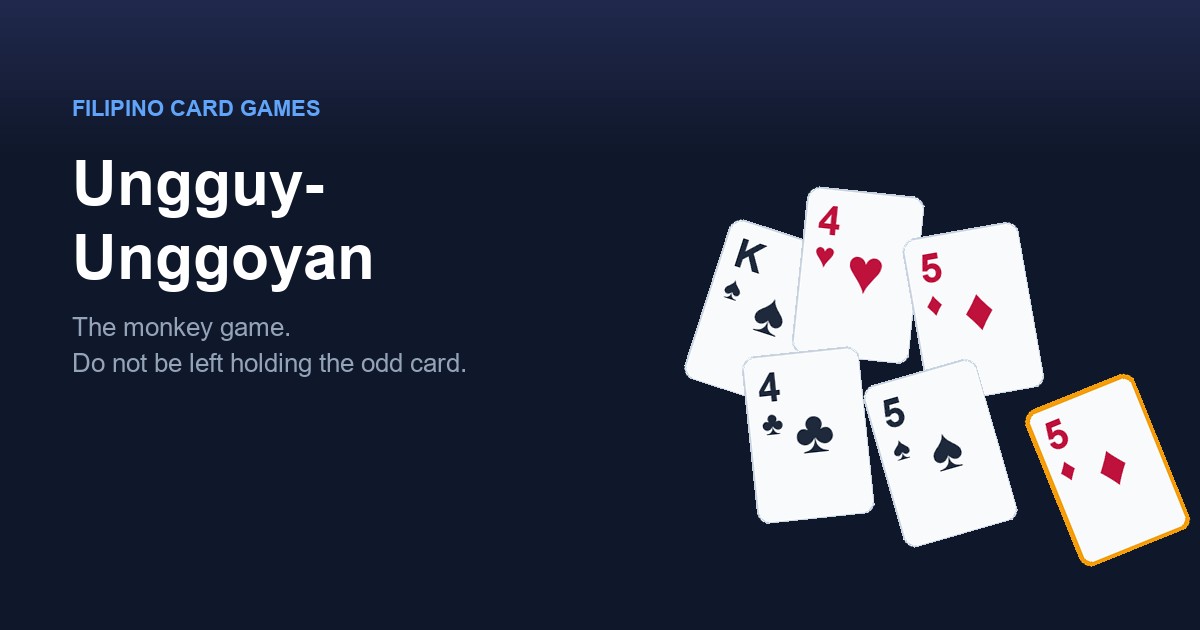
Ungguy-unggoyan is the Filipino pair-matching card game known in English as Old Maid. Players discard matching pairs, then draw from the player on their left; the player left holding the one card that cannot be paired loses. Unggoy is the Tagalog word for monkey, so the loser is the unggoy, and the game is also called Monkey-Monkey.
Quick reference
| Item | Detail | | Players | 2 to 8 | | Deck | One standard 52-card pack | | Cards dealt | All 51 remaining cards; hands may differ by one | | Pairs | Same rank only; suits are ignored | | Aim | Discard every pair; avoid the last unpaired card | | Length | About 10 to 20 minutes | | Type | Luck-based family game |
Players and cards
Ungguy-unggoyan works with two to eight players. One standard 52-card pack is enough, and jokers are not needed.
Before the deal, remove one card at random and put it face down where nobody can see it. Its partner, the other card of the same rank, becomes the one card that can never be paired, and whoever is left holding that partner at the end loses.
Any card can be removed. In the Old Maid version the missing card is always a queen; in ungguy-unggoyan it can be a 5, a jack, or any other rank, which is why the monkey is not always a queen.
The goal
The aim is to get rid of every card in pairs and not be the player left with the final unpaired card. Pairs are two cards of the same rank; suits do not matter, so 7♣ and 7♦ are a pair, and so are 7♥ and 7♠. There is no score: everyone who runs out of cards is safe, and one player is the unggoy.
The deal
Shuffle the pack, then deal one card at a time face down, starting with the player on the dealer’s left and moving around the table. Deal every card. Because one card was removed first, 51 cards remain, so hands do not have to be equal: with four players the split is 13, 13, 13 and 12.
Players pick up their cards and sort them by rank. Suits can be ignored. There is no order of play during the deal and no decision to make yet; the first job is to clear the pairs already in hand.
One draw, step by step
Before the first draw, every player lays out all pairs from their hand face down in front of them. If you hold three cards of the same rank, lay down only two and keep the third; that third card can still pair with a card you draw later. Suits are irrelevant at every stage.
The dealer now fans their remaining cards face down and offers the fan to the player on their left. That player takes one card without seeing its face and adds it to their hand. If the card completes a pair, the pair is laid face down with the others. If it does not, the card stays in hand.
The player who just drew fans their own remaining cards and offers them to the player on their left. That player draws one card, and the same step repeats around the table, always to the left. One draw is the whole move: there is no separate discard, and the drawer cannot choose a card by rank because the faces are hidden.
A player who runs out of cards is safe and leaves the round. The next player draws from the next player to the right who still has cards, so an empty hand is skipped. When only one player still has cards, the round is over.
Because the pairs are face down, the table does not show which ranks have gone. Players have to remember what they have seen and what they have discarded.
How the round ends
The round ends when only one player still has cards. That player is holding the single card that could not be paired, because its partner was the card removed before the deal, so that card has been out of play from the start.
The player holding that card loses. There is no winner and no score; the other players simply avoided the unggoy. At the end, flip over the removed card and show it to the table. It has the same rank as the final card, which shows why that card could not be paired.
The ending works the same with two players or eight: one card is left, one player holds it, and that player is the monkey.
One rule protects the ending. If a player lays down two cards that are not a pair, three unpaired cards remain at the end instead of one. The player who made the wrong discard loses, even if they are not holding the final card, because their mistake created the extra odd cards. Pairs are therefore checked when they are laid down, even though they stay face down for the rest of the round.
A worked example
The smallest useful example uses six cards and two players. Remove 5♠ before the deal and put it face down. Deal the other five cards: Ana gets K♠, 4♥ and 5♦; Ben gets K♥ and 4♣.
Neither player has a pair to lay down. K♠ and K♥ are split between the two hands, and 4♥ and 4♣ are split the same way. The opening pairs are empty, which is deliberate: it shows that pairing depends on drawing.
Ben draws first, from Ana’s fan, and gets 4♥. Ben now holds K♥, 4♣ and 4♥, lays down 4♣ and 4♥ as a pair, and keeps K♥. Ana is left with K♠ and 5♦.
Ana now draws from Ben’s fan. Ben has only K♥, so Ana draws K♥. Ana holds K♠, 5♦ and K♥, lays down K♠ and K♥ as a pair, and keeps 5♦. Ben has no cards and is safe.
Only 5♦ is left. Ana flips over the removed card: it is 5♠, the partner of 5♦. The two 5s could have paired, but 5♠ was removed before the deal, so 5♦ is the unpaired card. Ana loses and is the unggoy.
The six cards used were 5♠, 5♦, K♠, K♥, 4♥ and 4♣: six different cards, no repeats.
Variations
Some groups play the Old Maid version: one queen is removed, so the odd card is always a queen and the loser is the Old Maid. This page describes the Philippine version, where any card is removed and the monkey can be any rank. Others play several rounds and keep a tally of who was the monkey; the rules of each round do not change. The name Monkey-Monkey appears in some English descriptions of the game, and some families call the loser simply the monkey.
If you want a Filipino card game that ranks hands instead of matching pairs, our Pusoy guide explains how 13 cards become three hands.
FAQ
How many players can play ungguy-unggoyan?
Two to eight. More players mean smaller hands and longer waits.
How many cards does each player get?
It is not fixed. The whole pack is dealt after one card is removed, so the hands are as even as 51 cards allow. With four players, three get 13 and one gets 12.
Is ungguy-unggoyan the same as Old Maid?
The mechanism is the same: pair, discard, draw from the left, avoid the last card. Old Maid removes a queen; ungguy-unggoyan removes any card, so the monkey can be any rank.
Do you need jokers?
No. A standard 52-card pack is enough, and one card is removed before the deal.
Sources
- Bicycle Cards, Old Maid: https://bicyclecards.com/how-to-play/old-maid/. The pair-discard step, the three-of-a-kind rule, drawing from the left, and the one-card ending were checked against this page on 2026-11-05.
- Philippine variant note: the removed card is any card, not a queen, and it is flipped over at the end so players can see which card could not be paired.
Educational content. 18+ only.