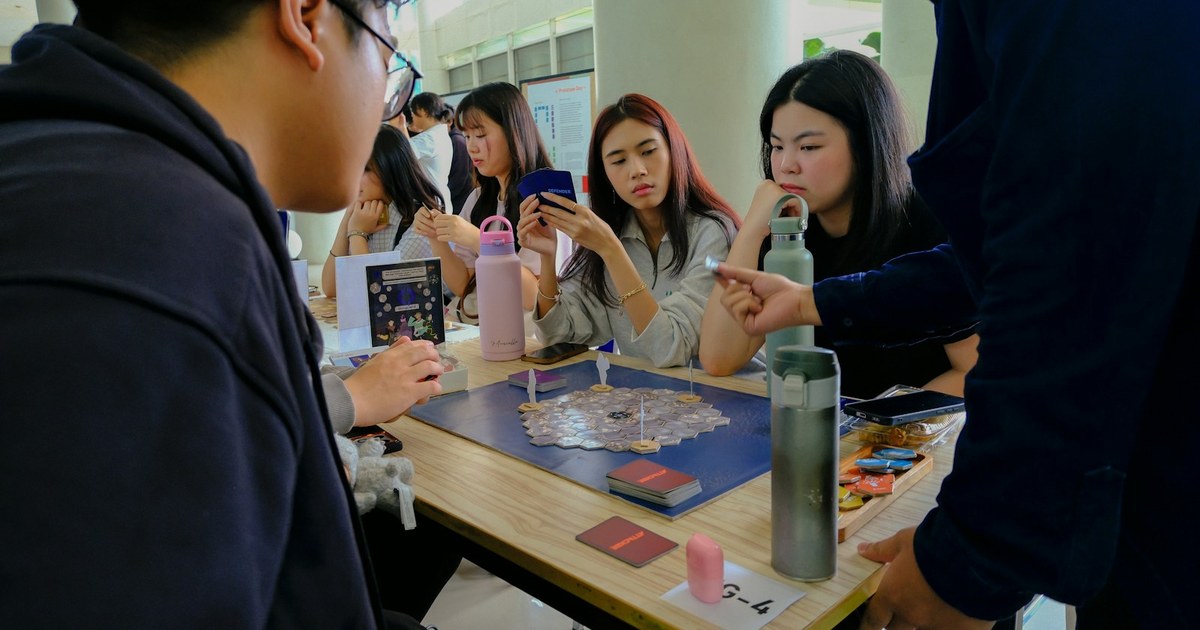
Cuajo, also written Kwaho or Kuwaho, is a Philippine partnership rummy game using 112 Spanish-suited cards. Four players draw and discard until one completes a 16-card hand in valid combinations. Kings cannot be discarded and can stand alone as combinations. This article follows the version documented by Pagat, including its purro call and scoring. Other accounts simplify or change those rules, so agree on the version first.
What you need
Use a complete Cuajo pack, with four copies of every rank-and-suit identity. A normal 52-card deck cannot reproduce it.
| Part of the pack | Contents | Count |
|---|---|---|
| Suits | Cups, Coins, Swords, Batons | 4 |
| Ranks in each suit | A, 3, 4, 5, Jack, Horse, King | 7 |
| Copies of each identity | Four identical cards | 4 |
| Cards in one suit | 7 ranks multiplied by 4 copies | 28 |
| Complete pack | 4 suits multiplied by 28 cards | 112 |
Seat four people with partners opposite. A partnership does not combine its cards: each player builds a separate hand. When recording results, combine the partners’ scores. For practice, use paper counters rather than money.
A Philippine guide describes Cuajo as having lost popularity to Pusoy and Tongits. That is a published account of its decline, not a current nationwide player count. Do not assume everyone who knows those games also knows Kwaho.
The card values and suits
These cards form combinations rather than tricks. There is no suit that automatically defeats another suit.
| English term | Name used here | Role |
|---|---|---|
| Cups | Kopas | One of four suits |
| Coins | Oros | Its kings have a higher scoring value |
| Swords | Espadas | One of four suits |
| Batons | Bastos | One of four suits |
| Jack | Sota | Joins Horse and King in a suited sequence |
| Horse | Kabayo | The middle picture card in that sequence |
| King | Hari | Cannot be discarded; valid alone |
| Ace | A | Can form a set or secret, but never a sequence |
The pack has no 2, 6, 7, 8 or 9. Its rank list does not create extra sequences: 5-Sota-Kabayo is invalid even though those cards are next to each other in a shortened list.
Setup and the deal
Deal and play anticlockwise. Choose the first dealer; the winner deals the next hand. The player on the dealer’s left cuts. Deal five cards to each other player and six to the dealer, then two further batches of five to everyone. The dealer has 16 cards; each other player has 15.
Turn the next card face up as the sowee. It is a scoring reference, not a card anyone may draw or meld. Put the stock across it so its identity remains visible. The arithmetic is 16 + 15 + 15 + 15 + 1 + 50 = 112.
The dealer begins by discarding one non-king, without drawing first. Everyone now has 15 cards, with one discard beside the 50-card stock.
How a turn works
Take the stock’s top card or the previous player’s top discard, then discard one non-king. Play moves to your right. You cannot search the discard pile or throw away a king to keep a more convenient hand.
Keep ordinary combinations concealed until declaring a win. A completed hand has 16 cards, each assigned to exactly one combination. Count any declared secret among those cards. Winning happens when the extra card completes the hand; do not discard back to 15 first.
For a secret, place four identical copies face down on your turn before discarding. Each of your two opponents records 50 source-cents in your favour; your partner neither pays nor receives anything. Those cards are locked and cannot be reused in other combinations.
There is a special sowee secret: its three remaining identical copies can be laid down with any fourth card. That fourth card stays locked and unseen too, but must still fit a valid combination in the eventual winning hand. A king is useful because it is valid alone. This exception is not permission to call any three identical cards a secret.
If the stock is exhausted without a winner, the hand is drawn. Keep already-recorded secret payments, add no winning-hand payment, and let the same player deal again.
The four valid combinations
| Combination | Requirement | Example |
|---|---|---|
| Set | Three or four equal ranks, all different suits | 5 Kopas, 5 Oros, 5 Espadas |
| Sequence | Exactly 3-4-5 or Sota-Kabayo-Hari, all one suit | 3 Bastos, 4 Bastos, 5 Bastos |
| Secret | Four identical copies of one rank and suit | Four separate copies of A Espadas |
| Single king | One Hari by itself | Hari Oros |
Three 5 Kopas are not an ordinary set. A 3-4-5 sequence cannot borrow its 5 for another set. The sowee-secret exception is explained above.
Here is a complete winning hand, with every card used once:
| Group | Cards | Count |
|---|---|---|
| Sequence | 3 Kopas, 4 Kopas, 5 Kopas | 3 |
| Sequence | 3 Oros, 4 Oros, 5 Oros | 3 |
| Set | A Kopas, A Oros, A Espadas | 3 |
| Sequence | Sota Espadas, Kabayo Espadas, Hari Espadas | 3 |
| Sequence | Sota Kopas, Kabayo Kopas, Hari Kopas | 3 |
| Single king | Hari Oros | 1 |
| Total | Five groups of three, plus one king | 16 |
Before completion, remove Kabayo Kopas from this layout: the remaining 15 cards are one card short. After declaring purro, drawing Kabayo Kopas yourself supplies the bounit and completes all six groups. Show all 16 cards; no card is discarded after the win.
Calling purro
Immediately after discarding, announce purro if one further card can complete your hand. Place a king face up as a reminder, or use a token if you have no king. A displayed king still belongs to your hand.
While someone is purro, other players expose cards drawn from the stock. If one completes your hand, call time and claim it. You may also finish on your own stock draw or on the previous player’s discard when your turn comes. You cannot claim another seat’s discard out of turn, or seize it after the next player takes it.
If several players can finish on a stock card, the drawer has priority if it completes their own hand. Otherwise priority goes to the eligible purro player whose turn comes first in anticlockwise order.
A compulsory king can spoil a waiting hand. If, after drawing and making a legal discard, you are no longer one card away, withdraw purro and remove the reminder. For your next two turns, show your stock draws and neither declare purro nor win. Normal eligibility returns on your third turn. Other players stop exposing stock draws only if nobody else remains purro.
Scoring
Published accounts disagree, particularly about self-drawn bounit payments. The figures below follow Pagat. They preserve the source’s cents numerically as practice score units, without converting them into modern money or identifying them as Spanish pesetas. Each amount is recorded against each opponent separately; the partner is exempt.
King value, written K below, is 50 per Hari Oros and 20 per king of another suit in the winning hand. In the worked hand, K = 50 + 20 + 20 = 90.
| Winning situation | Units from each opponent |
|---|---|
| Self-drawn bounit | 110 + K |
| Claimed or discarded bounit; both support tests met | 110 + K |
| Only bounit support test met | 60 + K |
| Only sowee support test met | 70 + K |
| Neither support test met | 20 + K |
| Porbis | 300, replacing the ordinary calculation |
For a claimed or discarded bounit, the first test is possessing its two supporting cards. For an ace, these are aces in two other, different suits. For any other rank, they are the two same-suit cards completing its permitted sequence. The second test requires a card identical to the sowee plus its two supporting cards.
Support cards need not be grouped together in the final layout. If either test fails, reveal up to 15 extra stock cards to seek the missing support. These are verification cards, not additions to the 16-card hand, and their kings add nothing to K. Apply the reduced rate if the tests still fail.
Porbis means no kings, or exactly one king used in a Sota-Kabayo-Hari sequence. It overrides the ordinary support tests and draw method. The worked hand is not porbis: it has three kings. Its self-drawn finish records 110 + 90 = 200 against each of two opponents, or 400 altogether, with no extra doubling.
Sources differ: PinoyWins adds a self-draw doubling that this version does not use. The cultural account’s author also allows an extra king payment with porbis in a comment; this guide follows Pagat’s stated 300 payment instead. Confirm these two scoring choices before mixing players from different tables.
FAQ
Are Cuajo, Kwaho and Kuwaho different games?
They are names associated with this game. Cuajo is a Spanish-style spelling; Kwaho and Kuwaho appear in Philippine usage. The name alone does not guarantee identical household rules, and there is no basis here for calling one spelling an official national standard.
Can a king be discarded or used twice?
Neither. A king cannot be discarded and can count in only one final combination, even though it could legally serve several different roles.
Does Secret collect 50 from all three other players?
Not in this version. Only the two opponents contribute. The partner is exempt, just as with a completed hand.
Is there a simpler game using an ordinary deck?
Pekwa card game rules use a standard 52-card pack and adjacent suit rows. Compare more Filipino card games before choosing a game for your group.
Sources
- Pagat: Cuajo, the selected rules account, including purro, support tests and porbis.
- Gambiter: Cuajo, matching text, not an independent confirmation of Pagat’s account.
- PinoyWins: Cuajo, deck and combination cross-check; its self-draw scoring differs and is not used here.
- Cuajo cultural account, additional pack context.
Educational content. Adults only.