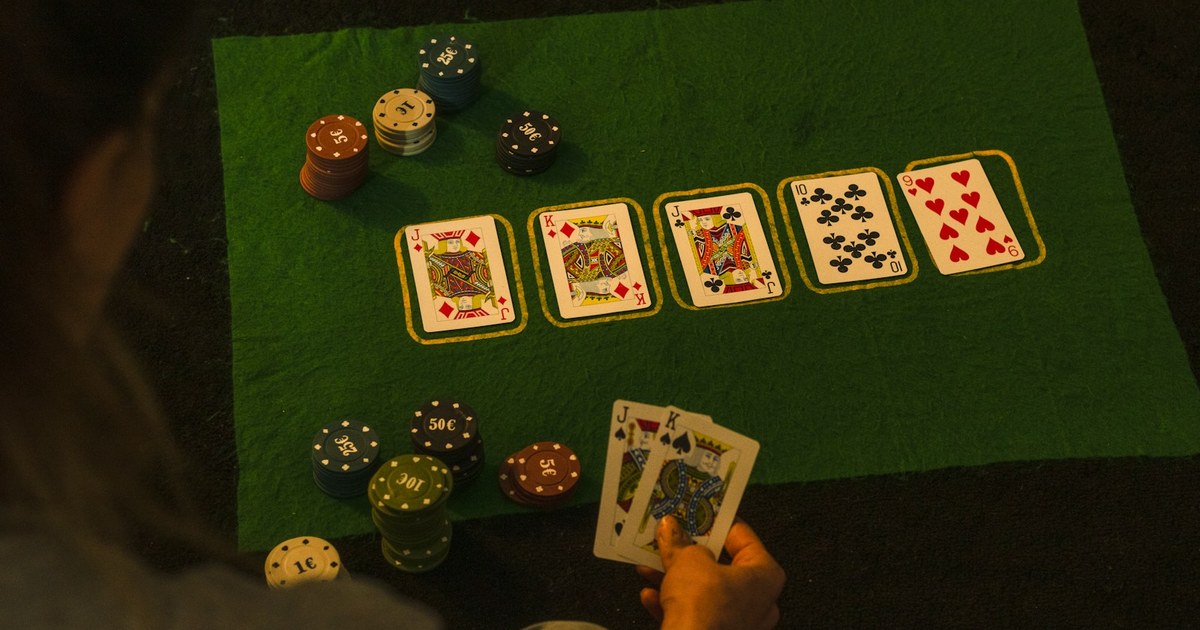
The pot is the total pile of chips that all players are competing for in the current hand; every bet, call and raise goes into it, and the winner of the hand takes it. Chips committed past the betting line belong to the pot, but what counts for each player is the portion they matched: when a player puts in more than the current bet, the unmatched excess is returned, and a player who cannot match a bet in full may go all-in for less.
How a Poker Pot Is Created and Funded
A poker pot grows as players invest chips during the betting rounds. In the example below, the first chips to enter the pot are mandatory investments called blinds; in games with antes, mandatory chips also go in before the betting starts, either one per player (a traditional ante) or a single payment by the big blind seat (a Big Blind Ante), depending on the event. If you are unfamiliar with these contributions, review our guide on what are blinds in poker.
The blinds you post in a hand belong to the pot from the start, whether you win the hand or fold; that is why folding never returns chips already in the pot. Once chips are placed across the betting line, they no longer belong to individual players. Even if a player surrenders their hand preflop, their posted chips remain in the center as dead money for the remaining participants to contest.
As the hand progresses, any player wishing to stay in the hand must at least call the current highest bet, though a player with fewer chips may go all-in for less; the unmatched part of larger bets is handled as described in the side pot section below. Every bet, call, and raise is pulled into the center, steadily increasing the total value of the pot.
Step-by-Step Example of Pot Calculation
To see how chips accumulate in practice, consider a table setup with blinds 10/20, three players, and no ante. Player A sits on the button, Player B posts the small blind, and Player C posts the big blind.
-
Preflop Setup:
- Player B posts the small blind of 10 chips.
- Player C posts the big blind of 20 chips.
- Player A, on the button, decides to enter the action and limps for 20 chips.
-
Preflop Resolution:
- The action returns to the small blind, who decides to fold. The small blind’s posted chips stay in the pot as dead money.
- The big blind checks, matching the 20-chip option without putting in additional chips.
- The total preflop pot is calculated as: 10 + 20 + 20 = 50.
-
Flop Action:
- The dealer deals the community cards, and the big blind acts first.
- With 50 chips already in the center, the big blind bets 35 chips.
- The displayed pot becomes 85 chips: this display includes the big blind’s outstanding bet of 35 chips, which still needs to be matched.
- If Player A calls 35, the closed pot is 50 + 35 + 35 = 120. If Player A instead folds, the unmatched 35 return to the big blind, who takes the 50 chips already in the pot.
Who Wins the Pot?
A hand can conclude in one of two ways:
- By Uncontested Action: If a player makes a bet or raise and everyone else folds, the last player standing takes the pot without showing cards, whatever cards they hold.
- At Showdown: If two or more players remain active after the final betting round, the best five-card hand takes the pot. To review which combinations beat which, consult the official poker hand rankings.
If hands are of exactly equal rank, the pot is split evenly among the eligible winners, and card suits never break a tie.
The Side Pot Boundary Explained
When a player cannot match the full current bet, the pot is settled in layers by matched amounts, not by how many chips remain in front of each player. Chips already committed by folded players stay in the pot but carry no claim to it, and only players who matched a given layer can win that layer.
Example, assuming no prior pot, no dead chips and no rake, with the figures representing total full-hand investments: Player A goes all-in for 100 chips, Player B bets 300 chips, and Player C can only call all-in for 200 chips. The main pot holds 300 chips, matched equally by all three and contested by A, B and C. The next layer is a side pot of 200 chips, formed by B’s extra 100 and C’s matched 100 above the main pot, contested only by B and C. B’s final unmatched 100 chips are returned to B. At showdown, the best hand among all three wins the main pot, and the better hand between B and C wins the side pot. The short-stacked player has zero claim to the side pot, regardless of hand strength.
3 Common Mistakes Beginners Make
- Counting the displayed pot twice when it already includes the last bet: the current pot total often already reflects the active bet. Adding that bet a second time leads to incorrect calculations.
- Forgetting that folded players’ chips stay in the pot: chips committed before folding do not exit the game.
- Thinking a player all-in for less can still win the side pot: an all-in player can only win the chips they matched. Layers formed above their matched amount belong to the players who matched those layers.
FAQ
Does a folded player get their blinds back?
No. The blinds you post in a hand belong to the pot from the start, whether you win the hand or fold; that is why folding never returns chips already in the pot.
Can card suits be used to break a tie for the pot?
No. If hands are of exactly equal rank, the pot is split evenly among the eligible winners, and card suits never break a tie.
What happens when two players have the exact same winning hand?
When two or more players show hands of identical rank at showdown, the pot is split evenly among the eligible winners.
Who can win a side pot?
Only the players who matched the chips in that layer are eligible to win it; a player who went all-in for fewer chips cannot win the side pot, and any excess bet above what opponents matched is returned to the bettor.
Sources
- The worked figures (blinds 10/20; preflop pot 10 + 20 + 20 = 50; closed flop pot 120; the 300-chip main pot and 200-chip side pot layering) can be re-checked by hand from the stated actions and assumptions.
- Pot handling, returned excess and side pot layering follow standard international poker procedures, such as the Poker TDA rulebook.
Educational content. Adults only.